

Many new and upcoming resources and events available to local educational agencies were discussed at the Aug. 13 California Collaborative for Educational Excellence (CCEE) board meeting.
Among them was the Statewide System of Support Toolkit that includes materials ranging from universal resources to data dashboards and self-assessment frameworks. “Under the Self-Assessment section, we have linked to the BASICS tool to help LEAs in their improvement journeys specifically serving students with disabilities, as well as the Levers for System Change tool, which is a newer self-assessment designed for LEAs to assess their systems and ultimately improve outcomes for all students,” according to the CCEE. “We also have the Universal PreKindergarten Technical Assistance Tool, which generates uniquely tailored options for the blending, braiding and layering of funding to enhance your Universal PreKindergarten infrastructure.”
For those wishing to better familiarize themselves with the Statewide System of Support (SSOS) and tools and resources available to support the work of their LEAs, registration is open for Connecting California, a free, virtual conference happening Nov. 18.
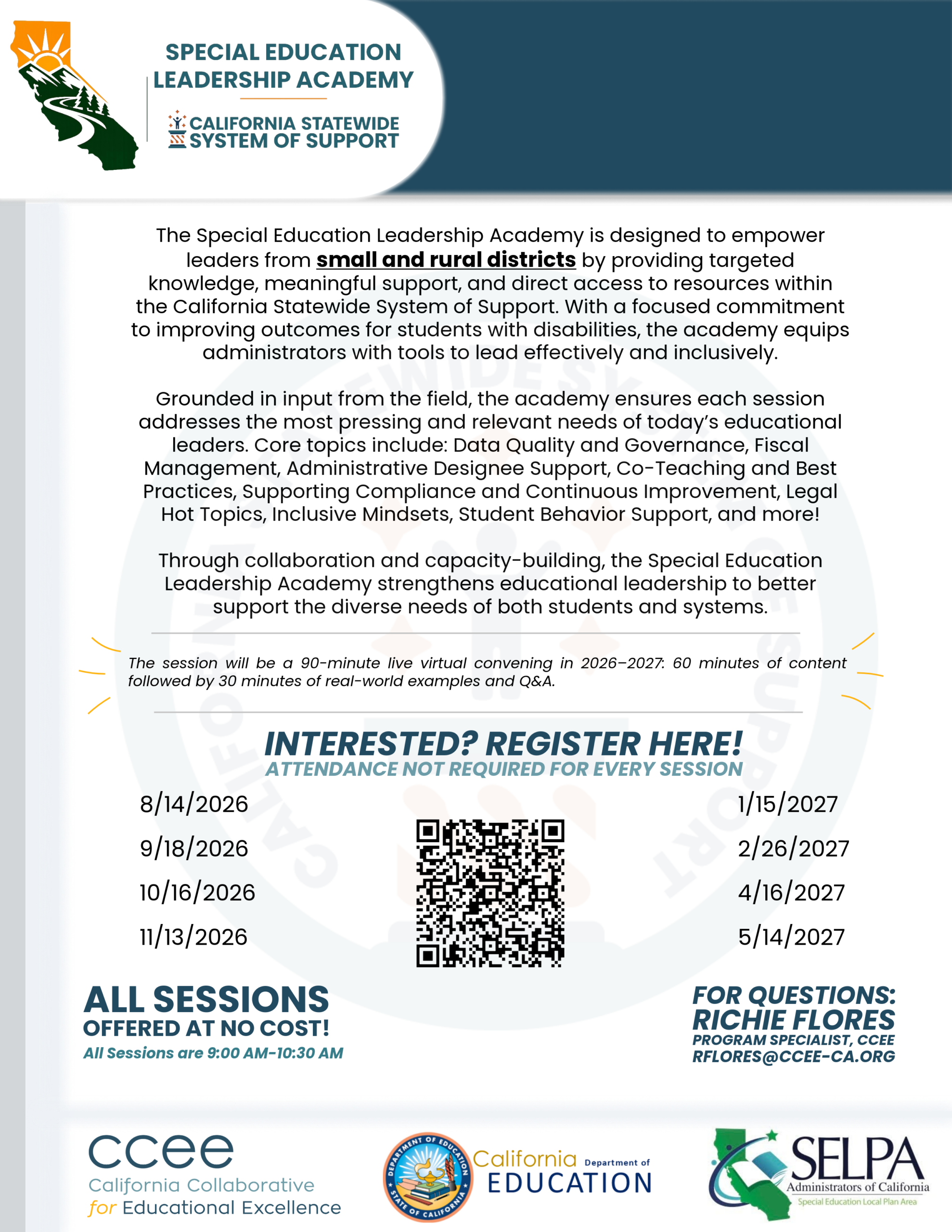
The CCEE is also hosting the no-cost Special Education Leadership Academy, which kicked off this month and is designed to “empower leaders from small and rural districts by providing targeted knowledge, meaningful support and direct access” to resources within the SSOS to improve outcomes for students with disabilities. Sessions, which take place virtually each month for 90 minutes, run through May 2027 and will cover topics including compliance and continuous improvement, inclusive practices, student behavior support, fiscal management and more.
Promising program outcomes
The board heard updates on promising outcomes related to LEAs involved in the African American Student Success Network, Learning Acceleration System Grant (LASG) programs, Direct Technical Assistance and the Intensive Assistance Model as well as associated data challenges.
Collecting data for the African American Student Success Network can be challenging as each participating LEA has their own problem of practice and data collection practices, for instance. Looking at student outcomes on California School Dashboard indicators between 2023 and 2025 in English language arts (ELA) and math, chronic absenteeism, suspension rates and career and college readiness, “network districts saw greater improvements in all outcomes for African American students as compared with the state average,” according to the presentation.
CCEE staff intend to further disaggregate data and the network’s goal is to continue supporting LEAs in meeting their problems of practice.
Drawing on findings from the year five LASG evaluation report, published in June, it was stated that the professional learning infrastructure included 36 county offices of education, 145 districts, 390 schools and more than 4,300 educators spanning the state. LASG funds support evidence-based professional learning for teachers to aid learning acceleration in subjects like math, literacy and language development.
Of participants, 87 percent reported changing their instructional practice due to LASG, many adopting asset-based approaches, increasing formative assessment use, utilizing learning progressions and implementing more interactive instructional strategies, according to CCEE staff.
Some key data points on LASG programs including the California Collaborative for Learning Acceleration (CCLA), Project CLEAR and the Rural Math Collaborative (RMC) indicate that students are being positively impacted.
According to the presentation, “Summerdale Elementary saw ELA proficiency increase by 11 percentage points and math proficiency increase by 5 percentage points after implementing accelerated literacy strategies supported through CCLA professional learning and coaching.” Additionally, results for the RMC showed that “84 second-grade students and 281 fourth-grade students participated in the Do the Math intervention program after 77 teachers across 15 counties were trained. Students demonstrated measurable gains in math achievement based on pre/post assessments.”
In other CCEE news:
- It was recently announced that applications are being accepted for the 2026–27 CCEE Data Academy through 3 p.m. on Aug. 21. The free statewide professional learning opportunity is meant to strengthen data capacity among education professionals with courses on data literacy, data inquiry and data leadership.
The board is scheduled to convene next on Dec. 17. A recording of the August meeting will be available here.