
What began as a response to requests from families for additional electives for their students enrolled in the Monson-Sultana Elementary School District has become a critical component of recent improvements in academic achievement, attendance and more.
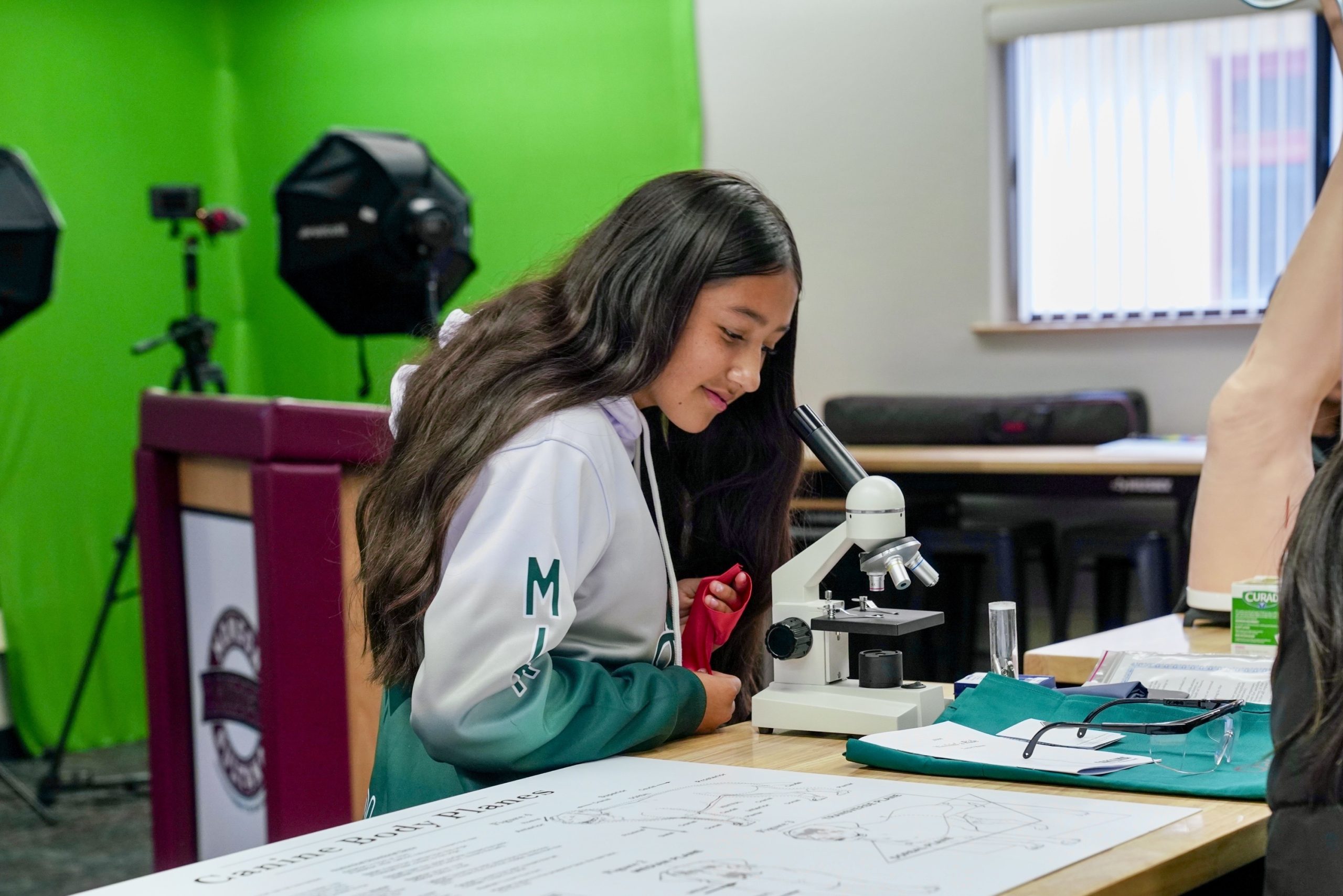
Through the district’s career technical education (CTE) program, students in grades 6-8 participate in rotations that allow them to explore areas including veterinary medicine, carpentry, cosmetology and barbering, human first aid, electrical engineering, culinary arts, child development, and aviation and drone technology.
This rural K-8 single school district in the Central Valley with an unduplicated pupil rate of about 87 percent serves about 440 students. Providing an opportunity to explore such an array of career possibilities has been a game changer, according to Superintendent-Principal Roberto Vaca.
“It’s been a big hit. I think for me as an instructional leader, the part that really gets to my heart is the engagement and how thankful the students are for having this opportunity,” Vaca said. “Students rotate through the various labs based on their interests and our goal is for all middle schoolers to have experienced all of these labs by the time they leave us, so when they get to high school, they have a stronger foundation and background.”
CSBA is recognizing the work of small districts through the Small Schools, Big Ideas blog series. Vaca explained how the program works, how the district got it off the ground, the benefits thus far and more.
The following conversation has been edited for length and clarity.
How did Monson-Sultana ESD get this program up and running and why was it a priority?
It’s one of the areas that I heard time after time from student focus groups, parent input on the [Local Control and Accountability Plan] surveys, from our staff members — that we needed to open up more doors for electives. Prior to this lab, the only electives were music, which was primarily choir, and physical education, which is not really an elective.
When we learned about the Paxton Patterson College & Career Ready Lab modules, I became very intrigued because this really solved a lot of the challenges with regards to offering electives. The way it works is the kids bring their Chromebooks to the class, they pretty much hit play and a person pops up on a video and says, “Today, we are going to learn how to make pancakes,” like for the culinary arts [for example], and it guides the students step-by-step with what they have to do. The teacher essentially is there just to facilitate and to ensure that students are on task. Throughout the lesson for that given day, students have to complete responses to prompts and each kid is given their own individual grade in the platform. So, there’s no grading involved, there’s no lesson planning involved.
We have funding through the Career Technical Education Incentive Grant (CTEIG), and that’s how we were able to purchase all these labs. Our initial investment was close to $70,000 to get it up and running and we started with about 10 modules. We wanted to make sure that they’re aligned to [the CTE offerings at] Dinuba High School because that’s where our kids are going.
We also looked at the community colleges in the area and the programs that they offer to help us home in on what makes the most sense. For example, aviation and drone technology were selected because our community college, Reedley College, has a full-blown aviation program where kids can go from learning how to fly a plane to being a mechanic for the planes. You take the kids on a tour to Reedley College so they can see it, feel it, experience it — and that’s where you start getting them to dream big.
What benefits have you seen among participating students?
We’ve seen a lot of positive gains. Test scores were one of our concerns because now it means that they have less time for English language arts (ELA), math, science, history since we’re stretching the daily schedule. We just have to find that alignment between the modules and the math, science and ELA standards, because it’s really to enhance that hands-on experience for our students. That was definitely a missing piece here at Monson-Sultana and it’s just a matter of getting creative and believing that it can be done. I have a very supportive school board and they’re laser focused on student achievement, they’re laser focused on student outcomes and experiences and culture.
In ELA proficiency, we grew 3 percent, but full transparency, we did drop 3 percent in math. Our [California Science Test] scores were through the roof. We went from 17 percent of students being proficient and advanced the last two years to 42.5 percent this year. Our [English Language Proficiency Assessments for California] for our English learner students — we went from 13 percent proficiency to 17 percent. We have close to a 98 percent attendance rate, and that’s huge for us. Just learning about vet science, for example, might be the connectedness piece that makes a student come to school every day. For a handful, it might be a novel that they’re reading in ELA or the concepts that they’re learning in math, but let’s be honest, it’s the hands-on stuff that gets kids to school.
We just became a California Schools to Watch this year. [The Schools to Watch program is a nationwide network that identifies model middle-grade schools deemed academically excellent, developmentally responsive, socially equitable and collaboratively led.] When the validation committee came in, one of the events they had was a parent focus group, and one of the questions was, “What would you want to see different as a parent based on your student’s experience?” What they said was, “We had several things that we recommended, but they’ve all been achieved. We said that we wanted more electives. They did it. We asked that we had a more comprehensive music program. They did it. We asked that they provide more mental health support. They got a grant and they hired more counselors, a social worker.” It doesn’t mean that we’ve arrived. It just means that we listen to our families.
How does the district plan on sustaining this program?
There are over 30 single school districts in Tulare County, and we are teamed up with an organization here called Valley Regional Occupational Program, and it’s a consortium of about eight to 10 school districts. Because Dinuba Unified School District is one of the districts in our consortium and because Monson-Sultana feeds into them, they include us in their annual application for the annual CTEIG grant. On a yearly basis we get approximately $20,000 in funding and they automatically write up their application every year and so that’s how we’re able to sustain it.
Each module can range from $4,000 to $7,000. And with this year’s allocation, we’re going to add two more modules. In fact, it’s on my list because we average about 25 to 30 kids in the lab and the goal is to get us to 15 modules so that it’s two kids per lab at any given time, whereas right now we’re doing three kids just because of the funding. We didn’t have enough to just do 15 modules out the gate.