

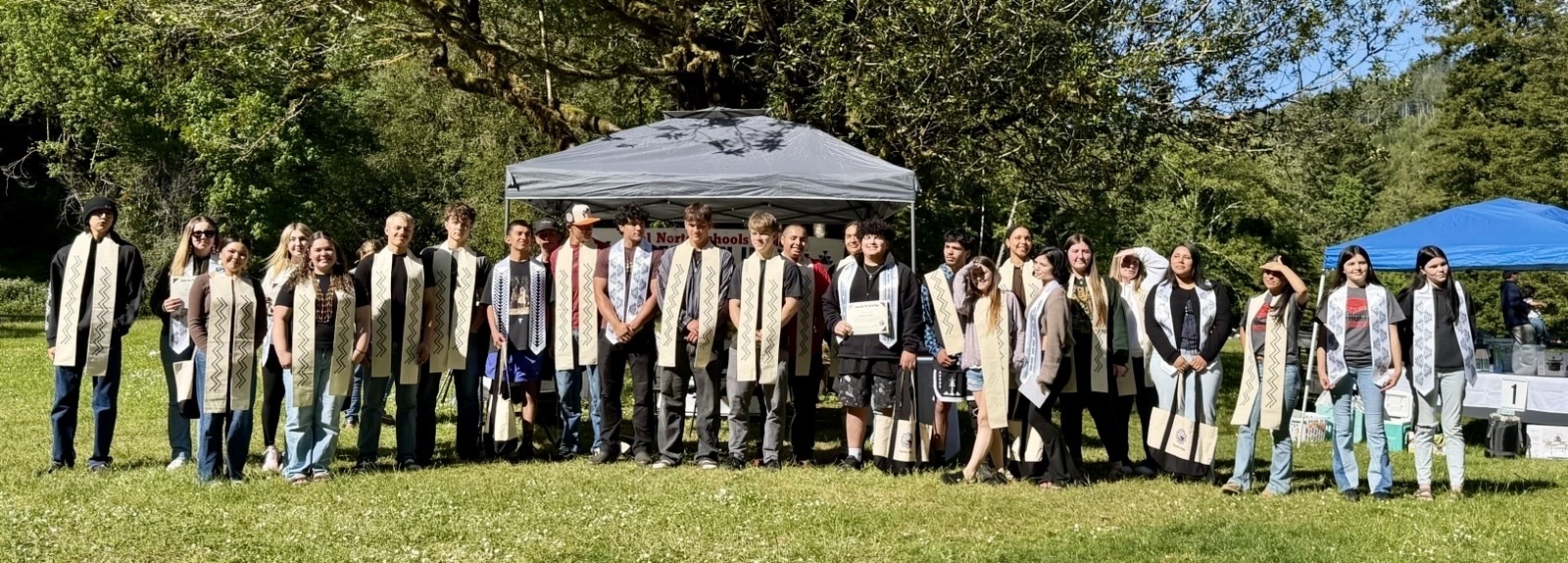
Native American Heritage Month, observed each November, serves as a reminder to local educational agencies to examine whether or not current policies, curriculum and more are contributing to ensuring schools are genuinely recognizing, respecting and nurturing Native American students. Del Norte Unified School District/County Office of Education’s Golden Bell-award winning tribal partnership program provides a powerful example of the importance of building strong relationships with local Indigenous tribes and the value of putting in the work to maintain them.
Del Norte USD/COE works closely with the Yurok Tribe, Tolowa Dee-ni’ Nation, Elk Valley Rancheria and Pulikla Tribe of Yurok Indians tribal governments to ensure quality services and outcomes for native youth. Programs include tribally led professional development, countywide curriculum, information sharing and wellness coalitions that honor tribal cultures in Del Norte schools.
These efforts have invigorated Del Norte students, staff and community, according to Superintendent Jeff Harris, who shared the experience of a staff member who attended a workshop earlier this year.
“She’s a Yurok tribal member. She said, ‘I got chills. It was the first time that I saw myself reflected in the work that we’re doing as a district,’” Harris said. “This is about recognizing that Native American culture is not history. There is a historical aspect to it, but it’s current. It’s contemporary. We’ve got phenomenal people who live here, who work here, who contribute here, who have contributed to U.S. history and California history, and need to be held up and recognized to the same extent that others are held up and recognized. There’s a relevance to it and where they can see their future, and that’s really what we’re trying to do in the long run.”
More than checking a box
When Harris joined Del Norte USD/COE about 12 years ago, the district was operating under an American Civil Liberties Union (ACLU) settlement agreement, but little had been accomplished. In meeting with representatives from the local tribes, the ACLU and district and COE staff, conversation turned toward the future.
“Was this just an opportunity to check some boxes to say we’ve done something or was it a way to really change the functionality and structure of how we supported kids?” Harris said. “We didn’t just want to check boxes. It wasn’t a compliance exercise. It was, ‘how do we really achieve something more? What are we really looking at? What are we looking for? What are we looking forward to?’”
Those meetings and efforts in subsequent years have led to a number of critical changes, he said. In addition to tribal elders talking to students about the history of the tribes, there is now a comprehensive, culturally grounded approach to teaching that includes Title VI Indian Education programming, locally developed American Indian curriculum, and career technical education opportunities.
Importantly, students in high school can take up to three years of Yurok and Tolowa Dee-ni’ language classes. “We’ve had kids earn the State Seal of Biliteracy in native languages, which is pretty cool,” Harris said. “As of 2019, the ACLU agreement had been met, but we didn’t drop it. As a matter of fact, we doubled down on it.”
Data sharing and continuing the work
The district/COE began working with Yurok leaders in education, social services and family services on a way to share information so that they could make tribal members aware of wraparound services available to them and provide supports beyond the reach of Del Norte schools.
The Family Educational Rights and Privacy Act (FERPA), a 1974 U.S. federal law that protects the privacy of student education records, initially proved to be a barrier.
“That’s an extremely important privacy rights protection for families, but with tribes that have their own government, it’s a government-to-government agreement too,” Harris explained. “We actually created a mirror school in our student information system, and in that ‘school’ we placed every student who was a Yurok-enrolled tribal member. We limited access to some demographic information, some broader information as part of our MOU between the district, the county and the tribe. And so, they actually have real time information on students. They can look up attendance. They can look up whether or not the student has an individualized education program. They can look up if the student has a flag for medical. They can look up all these different pieces. If they want to dive deeper, they have to get a release of information from a parent. But again, it was just removing a barrier to us communicating about students.”
These efforts are paying off. Del Norte schools have documented improved attendance, student wellness, family engagement and academic outcomes. “Our Native American kids are keeping pace with or outpacing some of our other subgroups on graduation rates,” Harris said.
Despite these successes, Harris noted that education leaders will not rest on their laurels. The historical trauma and disenfranchisement — the effects of which continue to permeate so many aspects of the lives of Indigenous children and families — cannot be undone through data sharing and updated curriculum alone.
“It takes forever to build trust, and it takes 20 seconds to destroy it. The work is never done. I don’t think it’s ever easy, but in 12 years, what I’ve seen is people who want what’s best for kids,” Harris said. “And sometimes it takes education, sometimes it takes compromise, but I think it’s always a work in progress, and we have some wonderful partners.
“As we look to the future, we’re looking at continuing to build. We’re looking at developing a set of cultural standards, just like we have content standards,” he continued. “We are looking at expanding services we have to native youth and to really starting to regionalize the work that my county office staff are doing to be able to support districts around who also have tribal youth but may not have access to the same level of professional development or planning and structural knowledge. We want to take the lessons that we’ve learned and share them with other districts.”