
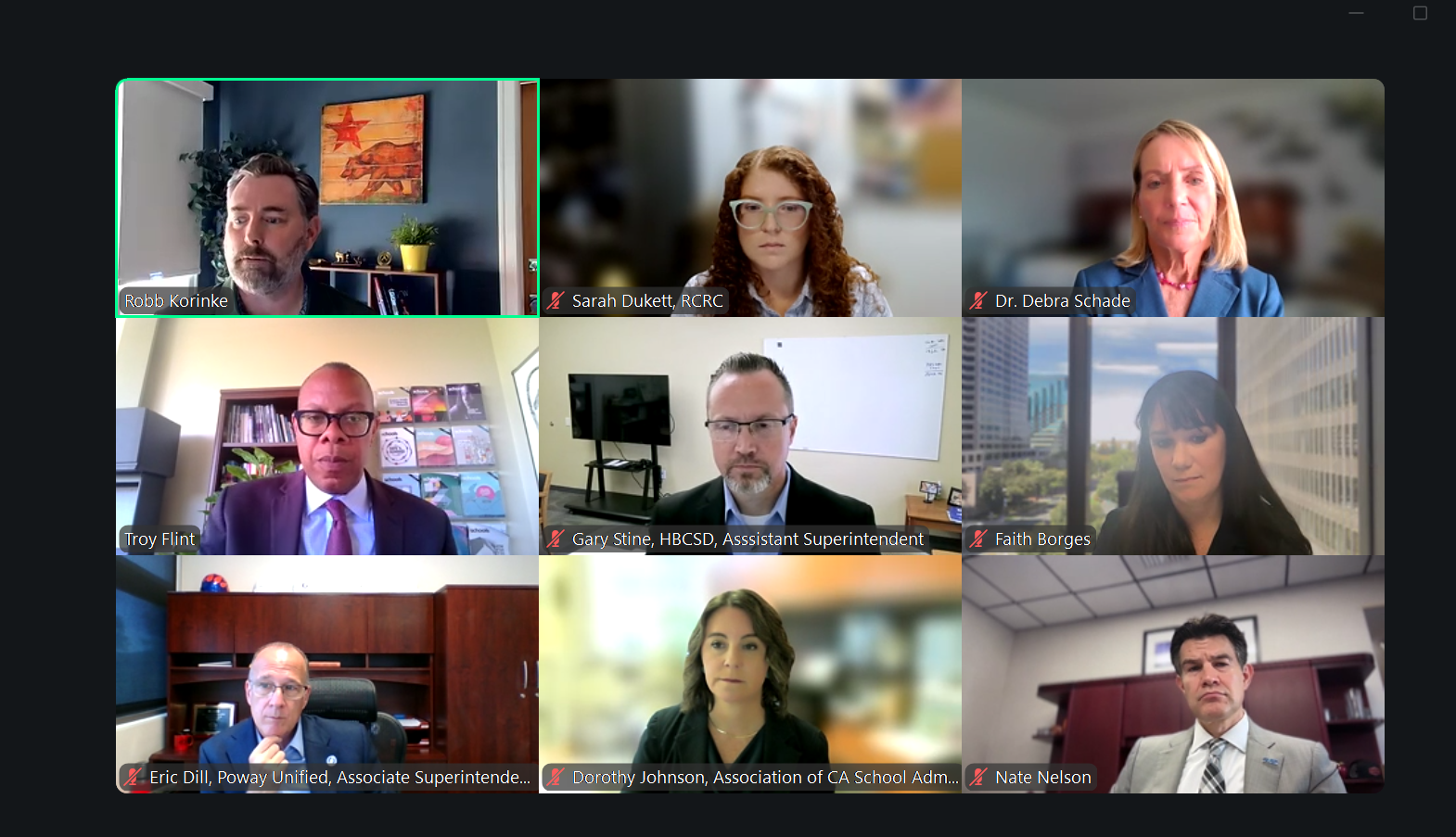
As California lawmakers consider reforms to Assembly Bill 218 in the final weeks of the legislative session, leaders representing school districts and public entities across the state held a virtual press briefing on Aug. 20 to discuss reforms that would preserve survivors’ ability to seek justice while establishing reasonable safeguards against unlimited publicly funded liability.
The event featured representatives from school districts, CSBA, the California Association of Joint Powers Authorities (CAJPA), the Association of California School Administrators, the California Association of School Business Officials and the Rural County Representatives of California.
AB 218, enacted in 2020, extended the statute of limitations for filing claims of childhood sexual assault to 40 years of age, or up to five years after discovery, whichever is later. The law also allows for actions to be commenced on or after a person’s 40th birthday if the local educational agency “knew or had reason to know, or was otherwise on notice, of any misconduct that created a risk of childhood sexual assault by an employee or volunteer, or if the school district or county superintendent failed to take reasonable steps or to implement reasonable safeguards to avoid acts of childhood sexual assault.”
Additionally, the law was enacted with a “lookback provision” that, between January 2020 and December 2022, allowed alleged victims of childhood sexual abuse from any time period before Jan. 1, 2009, to file suit for money damages against public agencies, including school districts and county offices of education, without having to comply with the Government Torts Claim Act.
A September 2024 CAJPA survey of multiple public entities including 300 school districts found that, in addition to escalating loss payments, they struggled to find insurance coverage with premiums escalating at an unsustainable pace, forcing many agencies to self-insure for millions of dollars. The survey also found that “taxpayer dollars are being used to fund claims exponentially, tripling from 2018–19 to 2023–24, and is projected to double again by 2026–27.”
CSBA President Dr. Debra Schade explained the importance of balancing the need to provide restitution to victims while ensuring the solvency of LEAs for current students.
“Childhood sexual abuse cases cause profound and lasting harm and is one of the most horrific crimes imaginable. Survivors deserve compassion, support, accountability and justice. That was the honorable purpose behind AB 218,” Schade said. “But [six] years after the law’s passage, California is confronting serious unintended consequences. School districts are diverting millions of dollars from classrooms. Insurance premiums are soaring. Insurers are leaving the market, and some districts face the possibility of insolvency.
“Those consequences are felt by today’s students through fewer teachers, larger classes, reduced counseling and mental health supports, and greater strain on special education,” Schade continued. “This is not a choice between survivors and students. California can preserve survivor rights and provide meaningful compensation while creating safeguards that keep schools and other public agencies from financial collapse. There is only one clear solution to this issue that balances both the needs of the victim and the needs of current and future students, and that is comprehensive tort reform.”
The group called on the Legislature to enact a tort reform package that includes:
- Defined benefits, including caps on damages in civil actions against public entities, ensuring survivors and other injured parties are made whole while preserving the capacity to deliver essential public services.
- Proportional liability for economic damages in civil actions against public entities so that taxpayers pay only for the share of harm actually attributable to the public agency. This way the perpetrators bear the cost of their own conduct and not taxpayers.
- Heightened evidentiary and procedural standards for claims where witnesses, records and evidence archives are absent or insufficient to assign culpability.
School leaders from Poway Unified School District and Huntington Beach City SD shared what the costs on the ground have been, and the programs they have affected.
“In the last four years, we have had to pay an additional $2.5 million dollars in contributions to our self-insurance fund, specifically for claims that tie back to AB 218 in this period of legacy claims,” explained Eric Dill, Poway USD associate superintendent of Business Support Services. “We don’t actually have any claims during that period, but we’re forced to make this contribution to help keep that fund solvent. And that has impacted every district that is a member of that self-insurance pool across the state. So, multiply that times the 1,000 school districts in California. At the same time, we have had to set aside millions of dollars out of our general fund to pay for claims that go back to the 1970s because we either have insufficient insurance to pay any settlements, or litigation arising out of those claims. But in some cases, we cannot find the evidence of insurance going back to 1971.”
He cited less funding overall from declining enrollment and said the money being set aside for insurance “could have reduced the impact on the cuts that we have had to struggle to make in this district.”
In Huntington Beach City SD, insurance increases due to AB 218 have been exponential. “On a per-student basis, these costs in Huntington Beach City SD have gone from roughly $80 per student before AB 218 was passed to $314 per student as of last year. That’s a 420 percent increase,” said Gary Stine, Huntington Beach City SD assistant superintendent of Administrative Services. “So, what does this mean for our students? It means less money is available to hire and pay teachers. It means increased class sizes, delayed projects — whether it be facilities or programs. It means that we’re not able to add additional counseling support that is being requested by our community because the funds are being redirected towards these claims and these assessments.”
CSBA President Schade flagged the particular struggles of small school districts. “The impact on a small or rural school district; one single claim can lead that district into insolvency. And that is a real fact in California. If you look at the number of small and rural school districts that make up our 1,000 school districts across California, that is significant impact, and it’s impossible to choose between the future education of California students and meeting the needs for survivors.”
CAJPA Legislative Advocate Faith Borges spoke of the difficulty of “threading the needle” between justice for victims, safeguards against faulty claims and solvency for public entities.
“We first and foremost do want to make sure that doors of justice remain open to victims,” Borges said. “The challenge from a policy perspective has been that while that is absolutely and unequivocally true, we also need to make sure that there are guardrails against fraudulent claims or predatory practices of attorneys that are driving trucks through the loopholes that have been created … the LA County case with up to 80 percent of claims having the potential to be fraudulent — that’s the public policy dilemma that we’re trying to solve for. AB 218 was well intended to open a door of justice for those who had previously been denied, but it didn’t consider the appropriate guardrails against what would ultimately become fraudulent or predatory claims due to the litigation model where trial attorneys are mining for victims with very little vetting required on their part and nothing put into statute for a public entity to defend against claims that are decades old.”