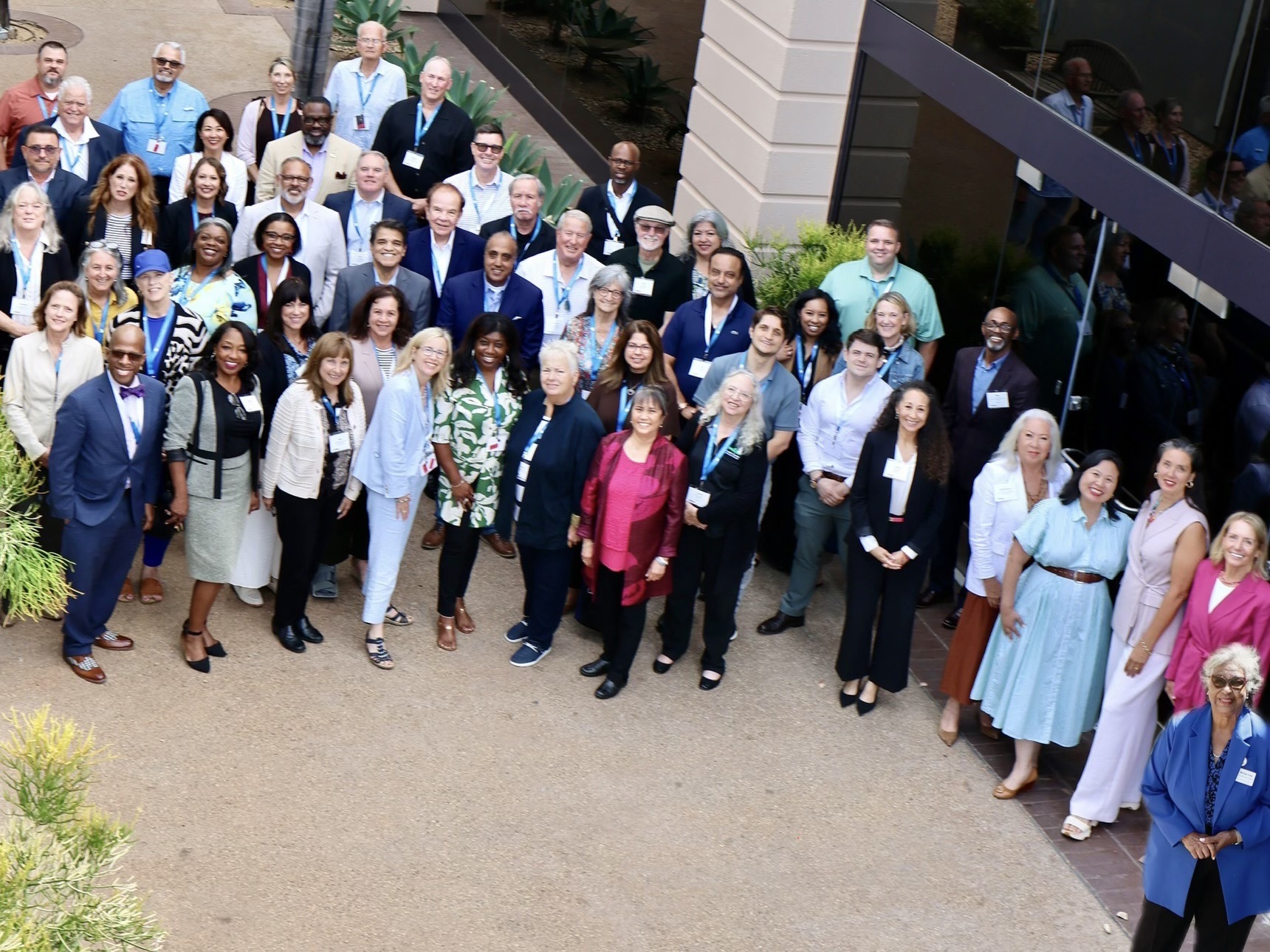


To build collective understanding about artificial intelligence (AI) and its potential role in education, in 2026–27, the Marin County Office of Education is hosting a multi-part AI Policy Development and Adoption Series for local district leaders.
This collaborative approach, which is intended to culminate in the development of policies for responsible AI use by students and staff, comes as the technology continues to rapidly advance and tools that can support teaching, learning and operations emerge.
“Our goal is to help districts navigate AI as thoughtfully, safely and responsibly as possible,” said Marin County Superintendent John Carroll. “None of us have the individual expertise to know exactly what’s going to happen with AI. I’m not sure anyone does, but we wanted to get together, put our minds together and come up with practical policies and guidance and strategies that we can sustain over time. Even though we know AI is going to be changing and those policies are probably going to have to be revisited frequently.”
The COE has partnered with Edapt — an organization that provides K-12 schools with training, compliance reporting and strategic advisory related to AI — to facilitate the sessions.
Through three sessions, which will run roughly three hours each, teams will work toward establishing board-ready AI policies that meet the needs and context of individual districts; acceptable use guidelines for staff and students; and actionable implementation strategies districts can apply to introduce, communicate and sustain policies and practices.
Districts can designate multiple individuals to participate, including superintendents, assistant superintendents, directors of technology or information technology leaders, directors of curriculum and instruction or educational services, and principals or other instructional leaders.
The series, which kicked off in October, will run through the duration of the 2026–27 academic year with regular virtual office hours conducted by Edapt as a supplementary opportunity where troubleshooting, processing, data collection support and preparation for presentations to district boards can be addressed.
Whether a district already has policies in place, is still in a rollout phase or has yet to explore the subject, the series aims to have beneficial elements for all to advance their efforts. During the initial session, for example, districts will be grouped with peers in similar stages to learn from others with like needs and challenges.
Working together
Carroll explained that the county has 17 school districts and that they regularly work closely with each other and the COE. The county office takes pride in focusing on key issues impacting the field such as early childhood education, the science of reading and college and career readiness as well as being responsive to emerging areas of interest, like AI and education technology.
He added that the local educational agencies are enthusiastic about the series and tackling the topic.
Having policies in place is especially important as AI continues to seep into education, being used by educators across the state, for example, to complete tasks like lesson planning and by many students on class assignments.
Carroll noted that talking about relevant concerns like ensuring it’s clear that AI is not replacing people or human judgment, privacy, safety, ethics and academic integrity are critical, as is understanding the opportunities and limitations associated with AI tools and approaching the technology with flexibility.
“I think there are two ways of looking at AI. One is to be afraid of it and be convinced that there’s something we can do to avoid it. And the other one is like, ‘Okay, it’s here. It’s part of the world,’” Carroll observed. “I think it’s our responsibility as educators to make sure that students have the knowledge, and especially the judgment, necessary to use it responsibly.”
In addition to the series, Marin COE is launching a monthly professional learning opportunity designed for employees at all levels of experience to build AI skills, discover new skills and workflows, and learn together, according to the county office.
For LEAs looking to learn more about AI, there is a suite of resources developed under the direction of CSBA’s AI Taskforce, including sample board policies and regulations, fact sheets, research briefs, guidance, webinars and more, available csba.org/AI.